What are Charisms? The word "charismatic" comes from the Greek word for "gift." There are many charisms, and God distributes them differently to different people. The Bible, in 1 Corinthians 7:7, shows us that everyone, "has a particular gift [charisma] from God, one of one kind and one of another."
The Catholic Church teaches about charisms in the Catechism of the Catholic Church (CCC), paragraphs 798 - 801:
They have a purpose: Through the charisms, the Holy Spirit, "makes the faithful 'fit and ready to undertake various tasks and offices for the renewal and building up of the Church.' (CCC 798)
They are good: "Whether extraordinary or simple and humble, charisms are graces of the Holy Spirit which directly or indirectly benefit the Church, ordered as they are to her building up, to the good of men, and to the needs of the world." (CCC 799)
We must welcome them: "Charisms are to be accepted with gratitude by the person who receives them and by all members of the Church as well. They are a wonderfully rich grace for the apostolic vitality and for the holiness of the entire Body of Christ, provided they really are genuine gifts of the Holy Spirit and are used in full conformity with authentic promptings of this same Spirit, that is, in keeping with charity, the true measure of all charisms." (CCC 800)
They must be discerned: "It is in this sense that discernment of charisms is always necessary. No charism is exempt from being referred and submitted to the Church's shepherds. 'Their office [is] not indeed to extinguish the Spirit, but to test all things and hold fast to what is good,' (1 Thessalonians 5:12,19-21) so that all the diverse and complementary charisms work together "for the common good." (CCC 801)
They are to be used: St. John of the Cross gives insights into the wise, humble and helpful use of charisms.
Where are Charisms in the Bible?
The Bible lists many charisms, including:
1 Corinthians chapter 12 lists gifts of Service, Wisdom, Knowledge, Faith, Healing, Miracles, Prophecy, Discernment of Spirits, Tongues, Interpretation of Tongues, Helping, Administration, Teaching, and Pastoring.
Romans 12:6-8 lists gifts of Prophecy, Ministry, Teaching, Exhortation, Giving, Leadership, and Mercy.
Talks about the Gifts of the Holy Spirit
Deacon Silva gave these talks at the Encounter prayer meetings in 2013. Listen by clicking the links or play them in YouTube at www.youtube.com/user/ArlingtonRenewal
"There are different kinds of spiritual gifts but the same Spirit." - 1 Corinthians 12:4
The Catholic Church teaches about charisms in the Catechism of the Catholic Church (CCC), paragraphs 798 - 801:
They have a purpose: Through the charisms, the Holy Spirit, "makes the faithful 'fit and ready to undertake various tasks and offices for the renewal and building up of the Church.' (CCC 798)
They are good: "Whether extraordinary or simple and humble, charisms are graces of the Holy Spirit which directly or indirectly benefit the Church, ordered as they are to her building up, to the good of men, and to the needs of the world." (CCC 799)
We must welcome them: "Charisms are to be accepted with gratitude by the person who receives them and by all members of the Church as well. They are a wonderfully rich grace for the apostolic vitality and for the holiness of the entire Body of Christ, provided they really are genuine gifts of the Holy Spirit and are used in full conformity with authentic promptings of this same Spirit, that is, in keeping with charity, the true measure of all charisms." (CCC 800)
They must be discerned: "It is in this sense that discernment of charisms is always necessary. No charism is exempt from being referred and submitted to the Church's shepherds. 'Their office [is] not indeed to extinguish the Spirit, but to test all things and hold fast to what is good,' (1 Thessalonians 5:12,19-21) so that all the diverse and complementary charisms work together "for the common good." (CCC 801)
They are to be used: St. John of the Cross gives insights into the wise, humble and helpful use of charisms.
Where are Charisms in the Bible?
The Bible lists many charisms, including:
1 Corinthians chapter 12 lists gifts of Service, Wisdom, Knowledge, Faith, Healing, Miracles, Prophecy, Discernment of Spirits, Tongues, Interpretation of Tongues, Helping, Administration, Teaching, and Pastoring.
Romans 12:6-8 lists gifts of Prophecy, Ministry, Teaching, Exhortation, Giving, Leadership, and Mercy.
Talks about the Gifts of the Holy Spirit
Deacon Silva gave these talks at the Encounter prayer meetings in 2013. Listen by clicking the links or play them in YouTube at www.youtube.com/user/ArlingtonRenewal
- Introduction to the Charismatic Gifts
- Charism of Tongues and Interpretation
- Charism of Prophecy
- Charism of Words of Wisdom and Knoweldge
- Charism of Healing
- Charism of Discernment of Spirits and Natural Discernment
- Integration of Charisms into Parish Life
"There are different kinds of spiritual gifts but the same Spirit." - 1 Corinthians 12:4
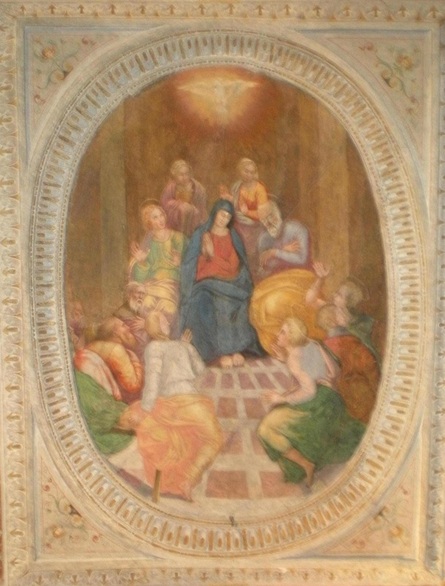
Individual people have different gifts, but together the Church shares all of them. Here are some teachings about that.
"In like manner we do also hear many brethren in the Church, who possess prophetic gifts, and who through the Spirit speak all kinds of languages, and bring to light for the general benefit the hidden things of men, and declare the mysteries of God." - St. Irenaeus, 2nd century bishop, Gaul (France), Against Heresies, Book V, Chapter 6.
"For the prophetical gifts remain with us, even to the present time." - St. Justin Martyr, 2nd century, Dialogue with Trypho, chapter 82.
1 Corinthians 12:11-25, "But one and the same Spirit produces all of these, distributing them individually to each person as he wishes. As a body is one though it has many parts, and all the parts of the body, though many, are one body, so also Christ. For in one Spirit we were all baptized into one body, whether Jews or Greeks, slaves or free persons, and we were all given to drink of one Spirit. Now the body is not a single part, but many. If a foot should say, "Because I am not a hand I do not belong to the body," it does not for this reason belong any less to the body. Or if an ear should say, "Because I am not an eye I do not belong to the body," it does not for this reason belong any less to the body. If the whole body were an eye, where would the hearing be? If the whole body were hearing, where would the sense of smell be? But as it is, God placed the parts, each one of them, in the body as he intended. If they were all one part, where would the body be? But as it is, there are many parts, yet one body. The eye cannot say to the hand, "I do not need you," nor again the head to the feet, "I do not need you." Indeed, the parts of the body that seem to be weaker are all the more necessary, and those parts of the body that we consider less honorable we surround with greater honor, and our less presentable parts are treated with greater propriety, whereas our more presentable parts do not need this. But God has so constructed the body as to give greater honor to a part that is without it, so that there may be no division in the body, but that the parts may have the same concern for one another."
1 Peter 4:10-11, "As each one has received a gift, use it to serve one another as good stewards of God's varied grace. Whoever preaches, let it be with the words of God; whoever serves, let it be with the strength that God supplies, so that in all things God may be glorified through Jesus Christ, to whom belong glory and dominion forever and ever."
Romans 12:4-6, "For as in one body we have many parts, and all the parts do not have the same function, so we, though many, are one body in Christ and individually parts of one another. Since we have gifts that differ according to the grace given to us, let us exercise them."
Pope Francis: "A second thought: the Holy Spirit would appear to create disorder in the Church, since he brings the diversity of charisms and gifts; yet all this, by his working, is a great source of wealth, for the Holy Spirit is the Spirit of unity, which does not mean uniformity, but which leads everything back to harmony. In the Church, it is the Holy Spirit who creates harmony. One of Fathers of the Church has an expression which I love: the Holy Spirit himself is harmony "Ipse harmonia est." Only the Spirit can awaken diversity, plurality and multiplicity, while at the same time building unity. Here too, when we are the ones who try to create diversity and close ourselves up in what makes us different and other, we bring division. When we are the ones who want to build unity in accordance with our human plans, we end up creating uniformity, standardization. But if instead we let ourselves be guided by the Spirit, richness, variety and diversity never become a source of conflict, because he impels us to experience variety within the communion of the Church. Journeying together in the Church, under the guidance of her pastors who possess a special charism and ministry, is a sign of the working of the Holy Spirit." - Pope Francis, homily at Pentecost Mass, May 19, 2013
St. John Paul II: "...to all Christians: Open yourselves docilely to the gifts of the Spirit! Accept gratefully and obediently the charisms which the Spirit never ceases to bestow on us!" - Pope John Paul II, Speech in St. Peter's Square, June 3, 1998
Pope Benedict XVI: "Every charism is in relation with the growth of the whole Body of Christ." - Pope Benedict XVI, address to the Emmanuel Community, February 3, 2011
Read more in the article Let the Fire Fall: Gifts of Charismatic Prayer in the Arlington Catholic Herald, February 22, 2007.